The Vision  /  What Abolition Actually Means

A Vegan
World

Not a world where we exploit animals kindly. A world where the question "how do we use them?" vanishes — because using them is off the table. This is not a wishlist of reforms. It is the consequence of a single principle taken seriously.

01 / The Bedrock

One Shift, Not a Thousand Fixes

Animals stop being property. Morally, and legally. That is the whole change.

Everything people imagine they have to fight for — the end of factory farming, the end of the slaughterhouse, the end of the testing lab — is not a separate goal. It is a downstream effect of one foundational shift.

Welfarism works the opposite way. It treats every cruelty as its own problem to be managed: a bigger cage here, a "humane" stun there, a voluntary standard somewhere else. The work never ends, because the thing that produces the cruelty — the status of animals as things we own and use — is left untouched.

Abolition pulls the root. Once animals are no longer property, the apparatus built on owning them has no ground left to stand on.

The Moral Shift

Animals hold one right: not to be used as a means to human ends. The obligation is simply that we end exploiting them — not that we manage every harm in nature.

The Legal Shift

Property status is abolished in law. An animal can no more be owned, used, or sold than a person can.

The Collapse

With no legal or moral basis to use animals, the industries built on use don't get reformed. They simply end.

02 / The Collapse

The Symptoms Drop Off On Their Own

These are not goals to be won one campaign at a time. Each one ends as a direct consequence of animals no longer being property. Read every line the same way: because they are not ours to use —

Vivisection & Testing
Because they are not ours to use

Animals cannot be used as laboratory instruments. The justification — that their interests can be traded away for ours — disappears with their property status.

Entertainment
Because they are not ours to use

No zoos, circuses, racing, or fighting. Using animals for human spectacle is not reformed into "ethical" use. The premise — that an animal exists to be displayed — is void.

Clothing & Products
Because they are not ours to use

Leather, fur, wool, down — anything that treats a sentient body as raw material. The supply chain has no foundation once the body at the start of it is not property.

Using Animals for Food
Because they are not ours to use

Not just the industry, but every use of an animal as a food source — backyard eggs, a family's "happy" hens, hobby beekeeping, hand-milked goats. The scale and the setting change nothing; the wrong is using them at all. Human food comes entirely from the plant world.
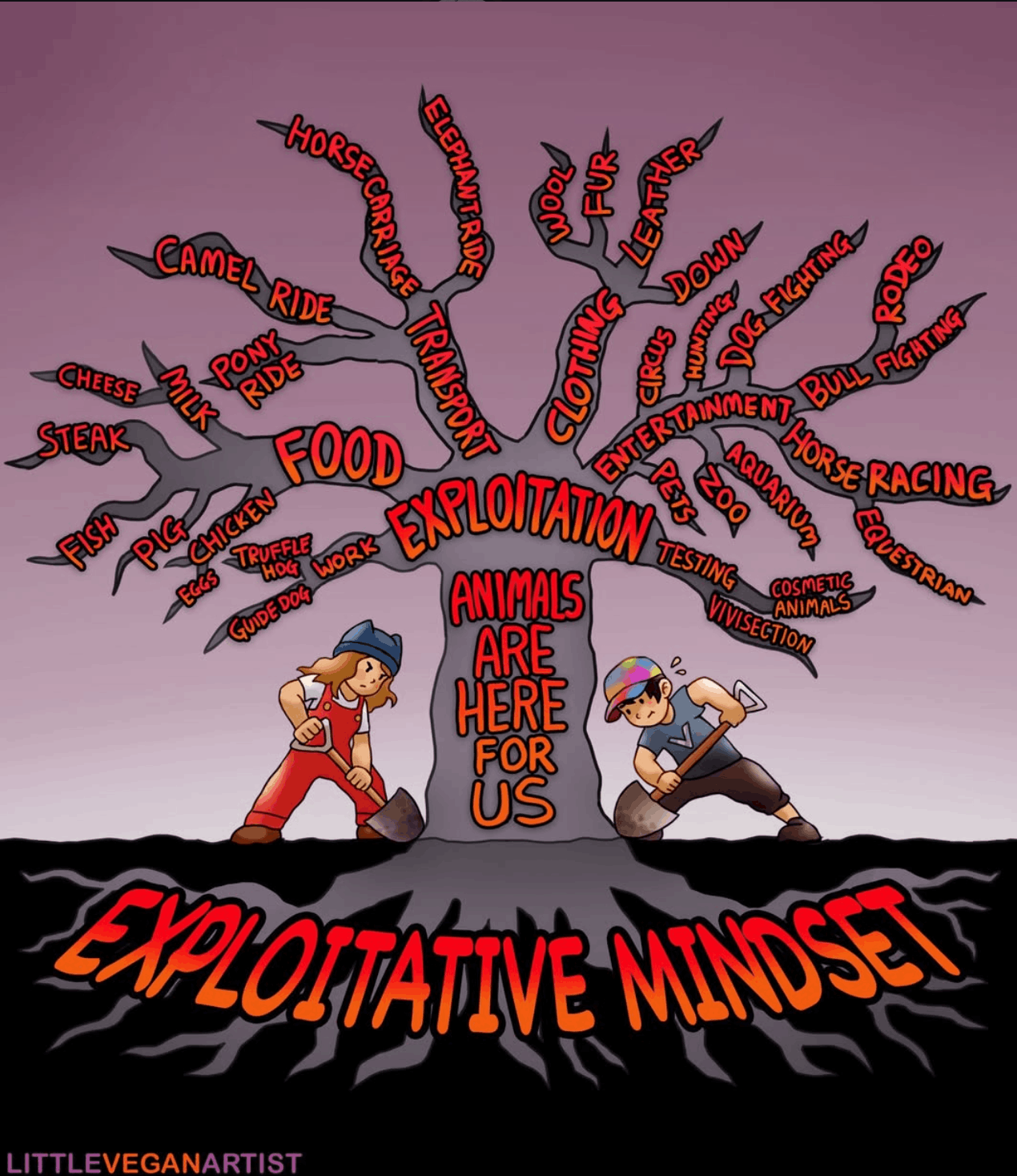
A tree whose many branches are labelled with forms of animal use (food, transport, clothing, entertainment, testing) all growing from a single trunk labelled 'Animals are here for us', rooted in the ground as an 'Exploitative Mindset'.
Illustration: @littleveganartist
03 / Honest Limits

What A Vegan World Is Not

Abolition is the moral floor. It is not the ceiling.

A vegan world does not end all suffering, and pretending otherwise would be dishonest. Animals will still die in the wild. Disease, predation, and accident do not answer to human law. Other injustices — between humans, and toward the planet — would not vanish overnight. These are separate issues from veganism.

What ends is regarding animals as ours to use: treating a sentient being as a resource, whether on an industrial scale or in a single back garden. That is the specific injustice veganism addresses.

This honesty matters. The vegan world is not a fantasy in which the lion lies down with the lamb. It is a world that has simply stopped treating animals as things to be used — and stopped calling that normal.

04 / Beyond Non-Use

We May Do More — But Never Outside The Principle

Ending use is not the end of moral concern; it is the beginning of it. There may be genuinely virtuous things we can do for animals — rescue, sanctuary, aid in crisis, the protection of habitat.

But none of it can ever come at the cost of using them. Non-use is the bedrock. Everything else is built on top of that floor, never in place of it. You cannot "help" animals by exploiting some of them, any more than you could help one group of people by enslaving another.

And so any use of an animal is treated as wrong in itself — not as a question of how the animal was used, but rejected on the ground that there is no right way to use them at all.

The Non-Negotiable

Whatever interactions we have with animals afterwards must rest on the principle of not using them. That is the bedrock the entire society is set on — and nothing virtuous can be built by breaking it.

05 / The Difference

Two Different Worlds

The welfare world and the vegan world are not two points on the same line. They rest on opposite foundations — and they lead to opposite places.

A Welfare World
A Vegan World
Status
WelfareAnimals remain property.
VeganProperty status is abolished.
Use
WelfareThey are still used — just "humanely."
VeganThe category of use no longer exists.
Cruelty
WelfareEvery cruelty is a permanent management problem.
VeganThe cruelties collapse with their root cause.
Reform
WelfareReform is endless, because the premise is intact.
VeganThere is nothing to reform — the apparatus is gone.
The Animal
WelfareExists, fundamentally, for us.
VeganExists for themselves.
The Point

This Is Not Idealism.
It Is Just The Logic.

A vegan world is not a naive dream bolted onto reality. It is what follows, step by step, the moment we stop treating animals as property. Reject that one premise, and the rest will rightfully follow.

Take the Quiz Why Welfare Fails